“Your formula took months to perfect. Your brand took years to build. Don’t let your packaging be the weak link that unravels both. Your packaging is the first and last handshake with your customer.”
In the competitive world of cosmetics and personal care, brands obsess, rightly, over formulations, ingredient sourcing, and brand identity. Yet one critical decision is frequently underestimated: packaging. Specifically, the temptation to cut costs by choosing the cheapest packaging option available.
It seems logical on the surface. Lower packaging cost means better margins. But what looks like a saving at the unit level often becomes a liability at the brand level. This article breaks down the real, measurable hidden costs of cheap cosmetic packaging and what smart brands do to avoid them.
Why “Cheap” Is Rarely Cheap
When brands evaluate packaging, they typically compare unit costs, the price per bottle, jar, or tube. What this calculation misses is total cost of ownership: the cumulative impact of packaging decisions across production, logistics, retail performance, customer experience, and brand equity.
A packaging unit that costs 20% less upfront may generate 3–5× that saving in downstream losses. Here are the four hidden costs that matter most.
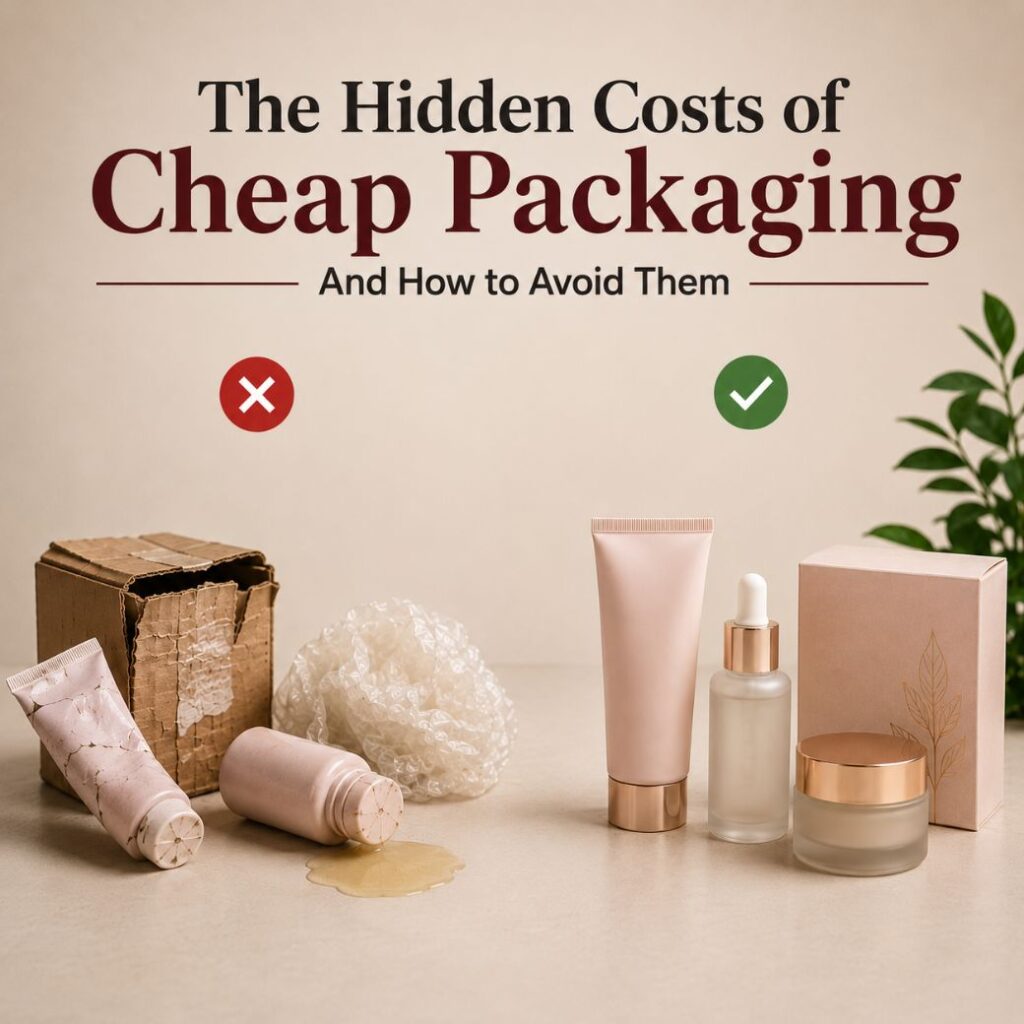
Substandard materials – thin walls, weak seals, brittle closures, lead directly to damaged goods in transit and at shelf. Return processing, restocking, and replacement shipping erode margins far beyond the initial packaging saving.
For beauty brands, packaging is the product experience before the product is experienced. Flimsy or poorly finished packaging signals low quality regardless of what is inside, and that impression is formed in seconds and rarely revised.
Poor barrier properties in cheap plastics or closures can compromise active ingredients, accelerate oxidation, and shorten shelf life. For premium skincare or actives-led formulations, this is not just a cost, it is a liability.
Premium retailers, department stores, and major online marketplaces maintain strict packaging standards, structural integrity, labelling, and finish quality. Brands with subpar packaging face delisting, failed audits, and lost distribution opportunities.
The Brand Equity Problem
Beyond the operational costs above, cheap packaging carries a subtler but more damaging consequence: brand devaluation. In a category driven by aspiration, trust, and sensory experience, the tactile and visual quality of your packaging is inseparable from the perceived quality of your product.
Consider how a customer engages with a new product. Before they ever apply it, they pick it up, feel its weight, read the label, open the cap. Every one of those moments is a brand interaction. Packaging that feels cheap, looks inconsistent, or opens awkwardly creates a mismatch between what your marketing promises and what the customer experiences. That gap is expensive to close.
The Total Cost of Ownership Framework
Smart brands evaluate packaging through a total cost of ownership (TCO) lens, a model that accounts for all costs associated with a packaging decision over its full lifecycle, not just the purchase price.
A basic TCO assessment for cosmetic packaging should include:
- Unit cost — the baseline: material, production, and tooling amortisation
- Compatibility cost — testing to ensure no formula-packaging interaction (discolouration, contamination, seal failure)
- Damage and return rate — projected losses from transit damage, customer returns, and replacement costs
- Retail compliance — cost of meeting retailer specifications, testing, and audit processes
- Brand conversion value — the measurable impact of packaging quality on conversion rate and average order value
- End-of-life obligations — regulatory and sustainability compliance costs, increasingly relevant in all major markets
When brands run this analysis honestly, the economics of premium packaging almost always hold — and the savings from cheap alternatives often disappear entirely.
How to Choose the Right Packaging Partner
The quality of your packaging is ultimately determined by the quality of your supplier relationship. A transactional supplier offers units at a price. A genuine packaging partner understands your formulation, your channel, your brand positioning, and your growth trajectory and builds specifications around all four.
What to look for in a cosmetic packaging partner
When evaluating packaging suppliers, ask the following questions directly:
- Do they offer formula-packaging compatibility testing as a standard part of the qualification process?
- Can they demonstrate experience across your specific channel — retail, DTC, travel retail, gifting?
- Do they provide barrier and shelf-life data for their materials relative to your formulation type?
- Are they familiar with the packaging standards of the retailers you target or aspire to enter?
- Can they scale with you – from launch quantities to commercial volumes, without compromising quality?
Think retail-ready from day one
One of the most common and costly mistakes emerging beauty brands make is designing packaging for DTC launch and then discovering it fails to meet retail requirements at the point of distribution. Structural integrity, label positioning, barcode placement, and fill tolerances are not afterthoughts, they are design parameters.
Building retail-readiness into your packaging specification from the beginning avoids expensive redesign, retooling, and rebranding costs later – costs that, for a growing brand, can be genuinely existential.
Sustainability: The Emerging Hidden Cost
An increasingly important dimension of packaging cost is regulatory compliance around sustainability. Extended producer responsibility (EPR) legislation, recyclability requirements, and restricted materials lists are advancing rapidly across the EU, UK, US, and key APAC markets.
Brands that chose the cheapest packaging without regard to material composition are now facing redesign, compliance cost, and in some markets, direct levies on non-recyclable packaging. This is no longer a reputational consideration, it is a financial one, and it is accelerating.
Building sustainability criteria into your packaging selection – material recyclability, mono-material construction, responsible sourcing, is not idealism. It is risk management for the next five years of your business.
Final Thought
Your packaging is the first and last physical handshake between your brand and your customer. It protects your formulation, communicates your values, and sets the emotional tone before a single drop is applied. It deserves the same considered investment as everything it contains.
The brands that understand this and build their packaging strategy accordingly are the ones that convert browsers into buyers, buyers into loyalists, and loyalists into advocates. The cost of doing it right is almost always less than the cost of doing it wrong.