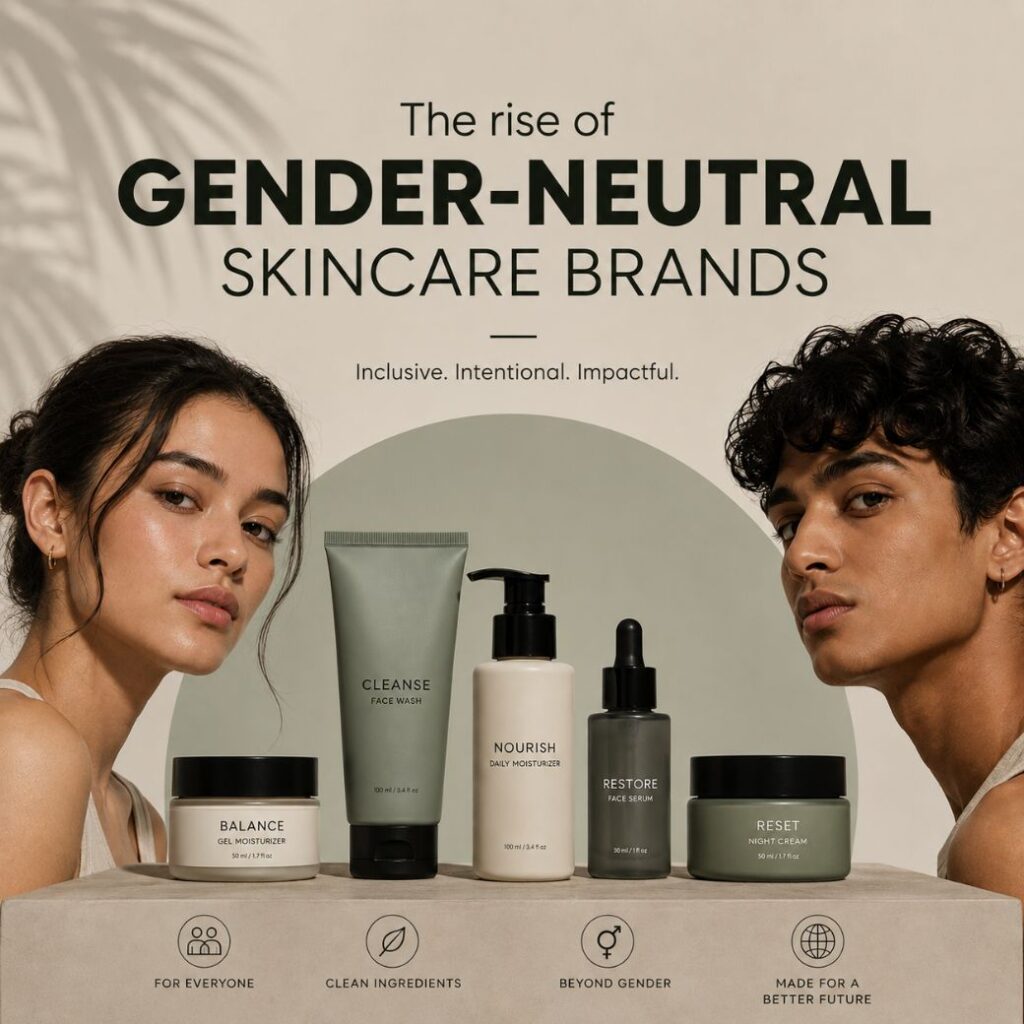
“Your skin doesn’t have a gender. So why does your skincare?”
For the longest time, that question went unasked. The beauty industry had its system, and the system worked or so it seemed. Pink packaging for women. Dark, angular bottles for men. Two separate aisles, two separate stories, two separate price tags.
But something shifted. Quietly at first, then all at once.
Today, gender-neutral skincare is one of the most talked-about movements in the beauty world and it’s not because of a marketing gimmick. It’s because consumers finally said out loud what many had been thinking for years: good skincare has nothing to do with gender.
Where It All Started
The concept didn’t emerge overnight. For years, there were early signals consumers mixing and matching products across the “men’s” and “women’s” aisles, routines being shared between partners, a growing frustration with products that felt more like costume than care.
Social media accelerated everything. When people started sharing their skincare routines openly online, the conversation shifted from “what’s made for me” to “what actually works.” Gender stopped being a useful filter. Results became the only metric that mattered.
That cultural shift created a vacuum and the beauty industry, always watching, moved to fill it.
Why This Movement Is Bigger Than Beauty
Gender-neutral skincare isn’t just a product category. It’s a reflection of a much larger cultural conversation happening around identity, self-expression, and authenticity.
Younger consumers, particularly Gen Z and Millennials, have grown up in a world that increasingly questions binary thinking across every dimension of life. They don’t see why their moisturizer should be any different.
For this generation, buying a product is a values statement. They want to support brands that see them as individuals, not as a checkbox in a demographic report. Brands that get this aren’t just winning a customer. They’re earning a loyal advocate.
And that loyalty is extraordinarily hard to buy back once it’s lost to a competitor who understood this sooner.
What Makes a Skincare Brand Truly Gender-Neutral?
This is where many brands get it wrong. Slapping “for all skin types” on existing packaging and calling it a day isn’t inclusion, it’s a sticker.
Truly gender-neutral skincare goes deeper than language. It lives in every decision a brand makes.
The formulation. Products built around skin needs – hydration, barrier protection, sensitivity, texture rather than assumptions about who is using them.
The design. Visuals, colors, and packaging that feel human rather than coded. Not aggressively minimalist to seem “unisex,” but genuinely thoughtful about who walks through the door.
The tone of voice. Copy that speaks to a person, not a gender. No “for the modern man” or “because she deserves it.” Just honest, direct communication about what the product does and why it matters.
The community. Who a brand chooses to feature, celebrate, and amplify says everything. Representation isn’t a campaign, it’s a commitment.
When all of these elements align, something powerful happens. The brand stops feeling like a product and starts feeling like a point of view.
The Business Case Is Undeniable
Beyond culture and values, the numbers make a compelling argument on their own.
The gender-neutral beauty segment has seen consistent growth year over year, outpacing several traditional categories. Consumers in this space tend to be highly engaged, research-driven, and vocal exactly the kind of customer base that builds a brand organically.
There’s also the matter of efficiency. A single cohesive product line that speaks to everyone simplifies everything from production to marketing to shelf placement. Less segmentation means sharper focus and sharper focus almost always translates into a stronger brand identity.
For startups and emerging brands especially, entering this space with a clear gender-neutral positioning can be a meaningful differentiator in a crowded market.
The Packaging Conversation Nobody Is Having Loudly Enough
Here’s something that often gets overlooked in discussions about gender-neutral beauty: packaging is doing more work than most people realize.
Before a consumer reads the ingredient list, before they see an ad, before they even pick up the product. they see the packaging. And in a split second, they’ve already formed an impression about who that product is for.
For gender-neutral brands, packaging isn’t just a container. It’s the first and loudest signal of intent.
Getting it right means moving beyond the default visual languages that the industry has leaned on for decades. It means thinking about form, material, color, and texture not as gender signals but as brand signals. It means asking: does this feel like it belongs to everyone?
The brands that are answering that question well are the ones building lasting equity. The ones that aren’t are quietly reinforcing the very divisions they claim to be dismantling.
What This Means for the Future of Skincare
The rise of gender-neutral skincare isn’t a moment, it’s a direction.
As the next generation of consumers grows into their purchasing power, the expectation of inclusivity will only deepen. Brands that have built genuine gender-neutral identities now will have a head start that’s nearly impossible to replicate later.
For those still on the fence, the window for early-mover advantage is closing but it hasn’t shut.
The most exciting chapter of this story is still being written. And the brands bold enough to lead it won’t just be selling skincare. They’ll be shaping what the industry looks like for the next decade.
Final Thought
The question was never really about gender. It was always about people.
The brands that understood this early didn’t just find a market opportunity, they found a more honest way to exist in the world. And in an industry built on the promise of feeling good in your own skin, that honesty might just be the most powerful ingredient of all.
If you’re building a gender-neutral skincare brand and thinking about how your packaging can reflect that vision, CMKart Global would love to be part of that conversation. Because great skincare deserves packaging that speaks the same language.
What are your thoughts on the gender-neutral skincare movement? We’d love to hear from you — drop a comment below or reach out directly.