The beauty industry is at a crossroads, and for new founders, the question is no longer whether to choose luxury or sustainability. It’s how to deliver both.
If you’re launching a cosmetic brand, you’ve probably felt the tension. You want packaging that looks undeniably premium, the kind that makes someone stop scrolling, pick it off a shelf, or feel excited to unwrap. But you also want to do right by the planet. You’ve heard the word “sustainable” thrown around so much it’s starting to feel hollow.
Here’s the good news: luxury and sustainability in cosmetic packaging are no longer opposites. In 2026, they’re becoming the same thing. And as a new founder, you’re entering the market at exactly the right time to build both into your brand from day one.
Why sustainable packaging used to feel “unluxurious”.
For years, eco-friendly packaging meant brown kraft boxes, matte recycled paper, and utilitarian design. Functional? Yes. Desirable? Debatable. Luxury brands leaned on heavy glass, metallics, rigid plastics, and elaborate multi-layer packaging to signal quality and exclusivity.
The assumption was simple: sustainability was a cost-cutting tool, not a brand-building one. But consumer expectations have shifted dramatically. Today’s beauty buyer, particularly millennials and Gen Z actively rewards brands that align with their values. Premium aesthetics and environmental responsibility are both expected.
Studies consistently show that over 70% of consumers are willing to pay more for sustainable packaging and in the beauty industry, that number is even higher among premium buyers. Sustainability is no longer a trade-off. It’s a value-add.
The four pillars of sustainable luxury packaging
For new founders, understanding how sustainability and luxury overlap is key to making smart sourcing decisions. Here are the four pillars to build your packaging strategy around:
- Recyclable & mono-material design: Single-material packaging (glass, aluminium, PCR plastic) can be both sleek and fully recyclable.
- Refillable systems: Luxury brands like Chanel and Dior now offer refills. Refillability signals longevity, a mark of true luxury.
- Premium sustainable materials: bamboo, sugarcane resin, mushroom packaging, and natural materials that photograph beautifully and feel elevated.
- Minimal & intentional design: Less material, more impact. Restraint in packaging is its own luxury language, and it’s inherently more sustainable.
Real examples: brands doing it right
You don’t have to imagine what this looks like; it’s already happening at every price point. Aesop built an entire global luxury brand identity around amber glass that feels timeless and is 100% recyclable. Ilia Beauty uses post-consumer recycled (PCR) aluminium tubes that feel just as premium as virgin material. Seed Phytonutrients ships their products in shower-safe paper bottles with a plastic liner you can separate and recycle separately.
These brands didn’t compromise on aesthetics. They redesigned around sustainability as a creative constraint, and their packaging became a core part of their brand story.
For a new founder, your packaging is your first product. It communicates your values before a single ingredient is applied to skin. Sustainable luxury packaging isn’t just responsible; it’s a competitive advantage that’s increasingly difficult for fast-fashion beauty brands to copy.
Practical tips for new founders: where to start
- Start with glass or aluminium. Both materials are infinitely recyclable, photograph beautifully, and signal quality without greenwashing. They’re also widely understood by consumers as premium and responsible.
- Minimise components. Every extra cap, insert, or layer adds waste and cost. A single-component design is cleaner, cheaper to produce at low MOQ, and visually more refined.
- Design for refillability from day one. It’s far harder to retrofit a refill system later. If your hero product is a serum, a foundation, or a fragrance, think about how a refill pod could work from your very first SKU.
- Choose soy or water-based inks for printing. The box matters too. Soy-based inks and FSC-certified paperboard are standard in sustainable luxury and readily available from most packaging suppliers.
- Be transparent in your storytelling. Don’t just say “eco-friendly”. Tell your customers exactly what your packaging is made from, where it goes after use, and why you chose it. Specificity builds trust and commands premium pricing.
The bottom line for new beauty founders
The most forward-thinking cosmetic brands of the next decade will not ask, “Can we afford to be sustainable?” They’ll ask, “Can we afford not to be?” Consumers are already there. Retailers are increasingly demanding it. And from a purely brand-building perspective, sustainable luxury packaging gives you a richer, more defensible story.
You’re not just selling a product. You’re selling a point of view. And in 2026, that point of view needs to be both beautiful and responsible.
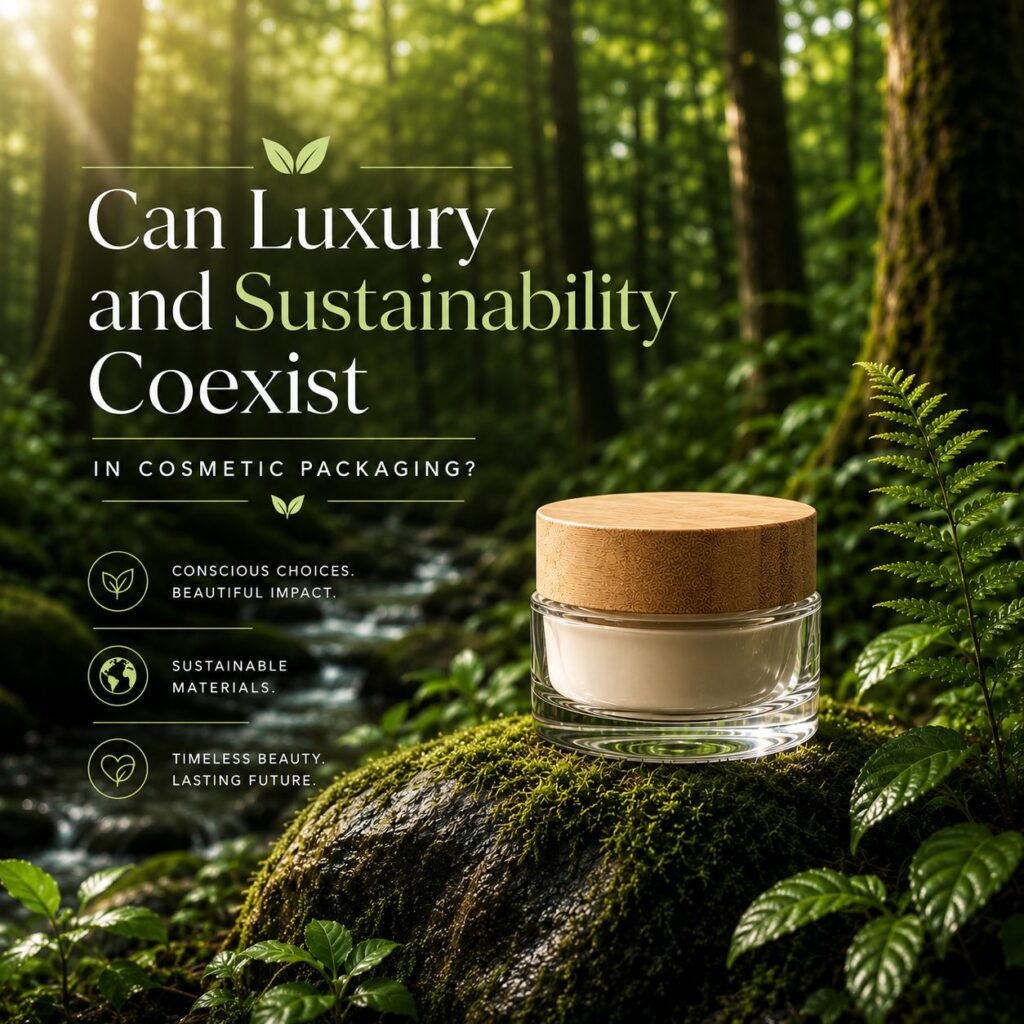
The answer to the question in our headline? Not only can luxury and sustainability coexist in cosmetic packaging, they’re becoming inseparable.
Ready to design your dream packaging?
Whether you’re launching your first SKU or scaling an existing range, we help new founders create packaging that’s premium, purposeful, and planet-friendly.