Nobody Told Us This Before We Got Into Packaging. So We’re Telling You.
Let me be upfront about something.
The biggest packaging mistakes we’ve seen from cosmetic brands across India had nothing to do with bad taste or bad budgets.
They happened because nobody sat these brands down early enough and asked the right questions.
We’ve been in this industry a long time. We’ve seen first-time founders launch their debut products with packaging that looked gorgeous and performed terribly. We’ve seen growing brands blow their Diwali launch window because a jar took six weeks longer than expected. We’ve seen compliance issues shut down export orders that took months to build.
Every single time, the problem wasn’t unfixable. It was just too late to fix cheaply.
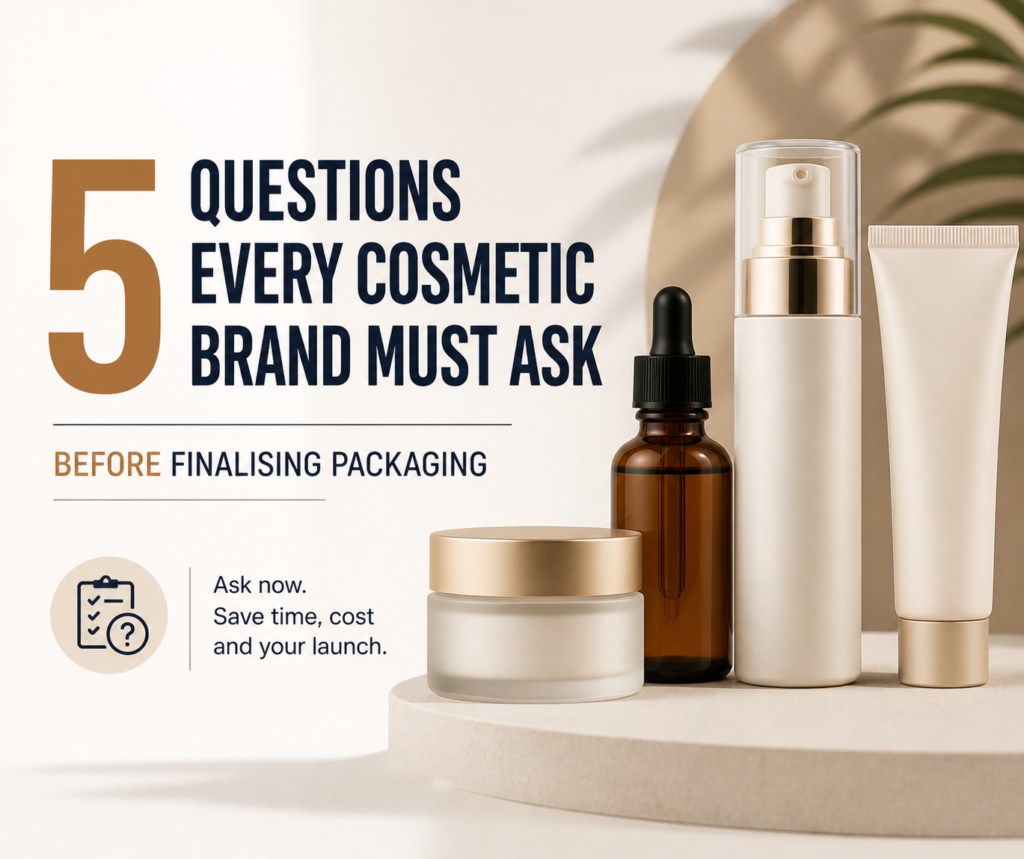
So here’s what we wish someone had handed every brand before they placed their first packaging order. Five questions. Simple ones. The kind that feel obvious in hindsight and save you a fortune in foresight.
Wait — is your packaging even compatible with your formula?
Yes, really. This is the one that surprises people most.
Here’s something the industry doesn’t talk about enough: packaging and formulas interact. Chemically. A Vitamin C serum in the wrong plastic degrades faster than it should. A high-pH cream can quietly react with metal pump components. An oil-heavy formula can slowly eat through a dispensing mechanism over months on shelf and you won’t know until customers start complaining.
We’ve watched brands fall completely in love with a frosted glass jar or a sleek airless bottle, place the order, fill the product… and then discover the problem. By that point? New tooling. New stock. Delayed launch. It’s an expensive lesson.
Airless bottles are a great example of this. Everyone wants them, they look premium, they protect actives from oxidation, they feel like a step up. And they are, when matched correctly. But if your formula is too thick, it won’t dispense. Too thin, and up to 30% of the product stays trapped at the base, completely unusable.
The bottle isn’t the problem. The mismatch is.
So before you fall in love with a format, ask: does my formula actually work inside this thing? Better yet — bring your packaging decision into the formulation stage. Let the two conversations happen at the same time. It’ll save you more than you know.
MOQ isn’t just a number on a quotation sheet. It’s a business decision.
Minimum Order Quantity. Sounds boring. Turns out it’s one of the most consequential calls a brand makes early on.
We’ve seen an early-stage founder commit to 10,000 jars because that was the supplier’s minimum. One year later, they were still sitting on 6,000 units. Capital locked in packaging. Formula creeping toward its shelf-life limit. No cash left to pivot or launch anything new.
We’ve also seen the opposite — a brand so cautious about over-ordering that they ran out of stock right in the middle of a campaign they’d spent months building. They never fully recovered that momentum.
The right MOQ isn’t always the smallest one available.
It’s the one that actually matches where your business is right now, your realistic sales forecast, your cash position, and your product’s shelf life.
Here’s a test worth doing before you sign off on any quantity: if you only sell 60% of what you’ve ordered, can the business absorb the rest without it hurting you?
If you hesitated answering that, revisit the number.
The lead time your supplier quoted? That’s the best-case version.
Here’s a story that plays out every single festive season in India.
Brand plans a Diwali launch. Supplier quotes 40-day lead time. Brand orders in early September, fully confident stock will arrive by mid-October. Formula is batched. Filler is booked. The marketing campaign is already live.
Then: port delay. QC rejection on arrival. A national holiday nobody had factored in. A bigger client jumps the queue.
Diwali becomes January.
The marketing money is gone. The seasonal window is shut. The team is exhausted.
The quoted lead time is almost always the best-case number. What it usually doesn’t include: customs clearance time, quality inspection on arrival, transit from port to warehouse, and your own internal production schedule once the packaging finally lands.
Add a 30% buffer. Minimum. If everything runs smoothly, great —you have stock early and you’re relaxed. If it doesn’t, you’re not scrambling and making expensive last-minute decisions.
Plan for reality, not the optimistic version.
Will this packaging still work when you’re doing 10x the volume?
Nobody thinks about this at 1,000 units.
It becomes a very expensive problem at 50,000.
Some packaging formats that work perfectly at small scale simply don’t translate to high volume. The custom mould that was affordable for your indie run becomes prohibitively costly when a high-volume filler needs a standardised format. The screen-printing or foil embossing that looked stunning on your first batch? The contract manufacturers you’ll graduate to as you scale may not even offer it.
But here’s the part that stings most , your packaging is a brand asset, not just a container. Your repeat customers know your product by how it looks, how it feels in their hand, the weight of it, the sound of it opening. The day you change the format — even for completely valid operational reasons , you’re asking your most loyal customers to trust you all over again.
The brands that avoid this headache are the ones who ask one simple question early: “What’s the maximum volume you can comfortably supply of this format?”
The answer tells you a lot about whether you’ve found a long-term packaging partner , or a good starting point you’ll eventually outgrow.
Grow into your packaging. Don’t grow out of it.
Check your compliance before the artwork goes to print.
This is the one everyone assumes is someone else’s job.
Legal will handle it. The printer will flag it. The regulatory consultant will catch it.
Until there’s a problem. And then suddenly it’s everyone’s problem, right now, very loudly.
In India, BIS and CDSCO requirements vary based on how your product is classified — cosmetic, quasi-drug, personal care. Each category has its own rules around labelling format, ingredient listing order, net quantity declaration, and the exact language you’re allowed to use in your claims. Get it wrong and you’re looking at reprinting, relabelling, or in the worst cases, a product recall.
Planning to export? It multiplies. The GCC, the EU, Southeast Asia — every market has its own approved ingredient lists, its own claim restrictions, its own packaging format requirements. What sails through Indian compliance may get stopped at a foreign port entirely.
And here’s the detail that costs brands the most money: compliance starts at the design stage, not the printing stage. If the box your designer has built doesn’t physically have space for all the mandatory label text at a legally acceptable size, that’s not a font problem. That’s a structural redesign. And it needs to happen before 10,000 units are printed, not after.
Brief your designer with compliance requirements before they open a design file. It’s the cheapest intervention there is.
So why does this keep happening?
Honestly? Not because brands don’t care. They care deeply.
It happens because packaging feels like the last step. Something you finalise once the formula is done, the branding is set, and the launch is around the corner. By then, there’s pressure to just move forward.
But the brands that consistently get packaging right, the ones who launch without chaos, scale without redesigning, and export without compliance headaches, they treat packaging as a first conversation, not a final one.
If you’re in the middle of a packaging decision right now, or one of these five questions made you pause , drop it in the comments. We’ve been through enough of these situations to know there’s no such thing as a silly question when money and timelines are on the line.