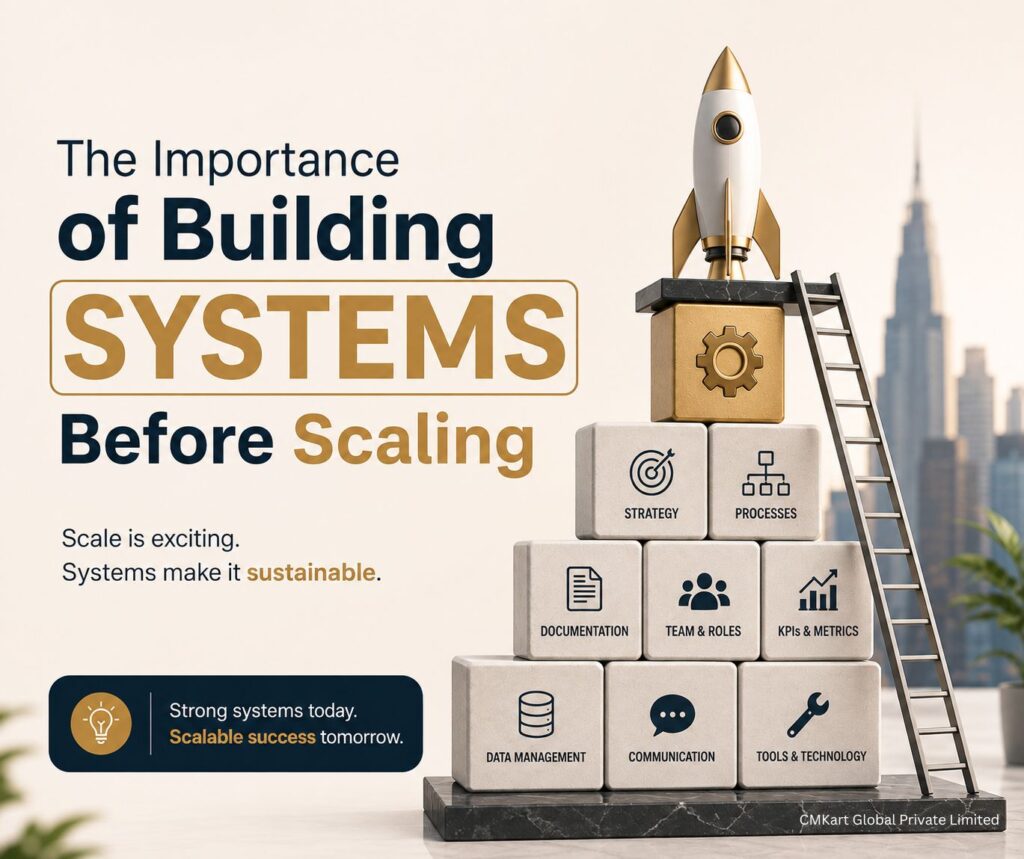
Picture this: a small business is finally taking off. Orders are coming in faster than expected, new clients are signing on every week, and the energy in the room feels electric. This is the moment every founder dreams about the payoff after months (or years) of grinding it out. But if you talk to people who’ve actually lived through this stage, many of them will tell you something surprising: this is often when things start to fall apart.
Not because the business is doing badly. Quite the opposite, it’s doing too well, too fast, for the way it’s currently structured to handle. Orders start slipping through the cracks. Customers who used to get a personal reply now wait days for a response. The person in charge, who used to have a handle on everything, suddenly feels like they’re drowning, putting out fires instead of steering the ship.
This isn’t bad luck. It’s a predictable pattern, and it has a name: growth without systems.
In the early days, most businesses run on instinct, memory, and sheer willpower. One person or a tiny team knows every client personally, remembers every detail, and fixes problems on the fly because there simply aren’t that many problems to fix yet. It’s inefficient, but it works, because the scale is small enough for a human brain to hold it all. The trouble starts the moment that scale changes and the way of working doesn’t change with it.
This is where “systems” stop being a nice-to-have and become the actual dividing line between businesses that grow sustainably and businesses that grow themselves into chaos. Before chasing more customers, more revenue, or more visibility, it’s worth pausing to ask a much more important question: is this business actually built to handle more? Because scaling without a real answer to that question doesn’t multiply success, it multiplies whatever weaknesses are already quietly sitting there.
Let’s break down why this happens, what a “system” really means in practice, and how to build one before you need it not after.
Why Scaling Without Systems Backfires
Think of a small business like a person carrying groceries in their arms. With two bags, they can manage nothing falls, nothing breaks. But hand them ten bags with no cart, no basket, no plan for carrying them, and something is going to hit the floor. Growth works the same way. It’s not the weight that causes the mess; it’s the lack of something to carry it.
When there’s no system in place, growth tends to expose itself in very specific, very frustrating ways:
- Tasks slip through the cracks not because anyone is careless, but because nothing was written down, so nothing is being tracked.
- New hires take forever to become useful because there’s no clear process to hand them; they’re left guessing, asking constant questions, or learning by making mistakes.
- Quality becomes inconsistent; what worked perfectly when one person did everything by hand starts to vary once more people (or more volume) are involved.
- One person becomes a bottleneck; every decision, no matter how small, still has to pass through them, because nobody else has the information or authority to make the call.
Here’s the important part: growth didn’t cause any of this. It just made problems that were already there problems that were easy to ignore at a small scale—impossible to ignore any longer.
What “Systems” Actually Means (It’s Simpler Than You Think)
The word “systems” can sound intimidating like something only big corporations with fancy software need. But at its core, a system is something much simpler:
A system is just a repeatable way of doing something well, without having to figure it out from scratch every single time.
That’s it. It doesn’t need to be complicated, expensive, or high-tech. Some of the most effective systems are as simple as a checklist or a shared document. A few everyday examples:
- An onboarding process for new clients or vendors, so nothing important gets missed and every new relationship starts the same reliable way
- A quality-control checklist used before anything goes out the door, so standards don’t depend on who happens to be doing the work that day
- A clear sales or lead pipeline, so everyone knows exactly what stage a prospective customer is in and what happens next
- Templates for recurring communication updates, follow-ups, reports, so the same message doesn’t have to be rewritten from scratch every time
- Clearly defined roles and responsibilities, so people know exactly what they own and, just as importantly, what they don’t need to worry about
The common thread in all of these? They take knowledge that used to live only in one person’s head and turn it into something the whole team can rely on even on a day when that one person is out sick, on vacation, or simply stretched too thin to answer every question personally.
The Real Cost of Skipping This Step
Here’s the tricky part: businesses that scale without systems often look successful from the outside. Revenue is climbing. New customers keep arriving. Activity is high. It’s easy to mistake motion for progress.
But underneath that surface-level success, things are usually fraying:
- Efficiency quietly drops, because small problems multiply faster than anyone has time to fix them
- Trust erodes because customers notice when quality becomes unpredictable, even if they can’t quite explain why
- Burnout creeps in because the people running things are spending all their energy firefighting instead of building
- Decision-making slows down, ironically, at the exact moment speed matters most
There’s an honest reason so many businesses skip this step: building systems feels slow. It feels like time that could be spent chasing the next client, the next deal, the next opportunity instead of writing a checklist nobody’s excited about. But think of it this way: adding more floors to a building without pouring a proper foundation first might hold up for a while. It will not hold up forever. Eventually, the weight catches up with the structure.
The Right Order: Systems First, Then Scale
The businesses that manage to grow well, not just big, but sustainably tend to follow a fairly simple, repeatable sequence:
- Do the work manually first. Before automating or handing something off, understand exactly what “doing it well” actually looks like. You can’t systemize something you don’t fully understand yet.
- Document what works. Once a process is proven, write it down. Turn it into something repeatable, something that doesn’t live only in one person’s memory.
- Test the system at a small scale. Try it with a small batch, a small team, or a limited rollout. Find the gaps and fix them while the stakes are still low.
- Then and only then scale. Now, growth adds pressure to a structure that’s actually built to absorb it, instead of one that’s held together by good intentions and long hours.
Most of the painful growing pains businesses experience come from skipping straight to step four, scaling first, and hoping the systems will somehow catch up later. They rarely do on their own.
The Real Payoff: Systems Create Freedom, Not Just Order
It’s easy to think of systems as restrictive, like extra rules, extra paperwork, and extra bureaucracy. But in practice, the opposite is true. Systems create freedom.
A business with solid systems in place can:
- Grow without every transaction needing personal oversight from leadership
- Bring on new people who become productive in days, not months
- Maintain consistent quality even as volume increases
- Let the people at the top actually think strategically, instead of constantly reacting
In other words, systems are what allow growth to compound instead of collapse. Without them, more customers just means more chaos. With them, more customers means the business genuinely gets stronger.
The Takeaway
Scaling isn’t really about doing more faster. It’s about building something sturdy enough to handle more and doing that groundwork before the growth arrives, not scrambling to catch up once it does.
The businesses that last aren’t always the ones that grew the fastest. They’re the ones that took the time to build a foundation strong enough to carry the weight of everything that came after.