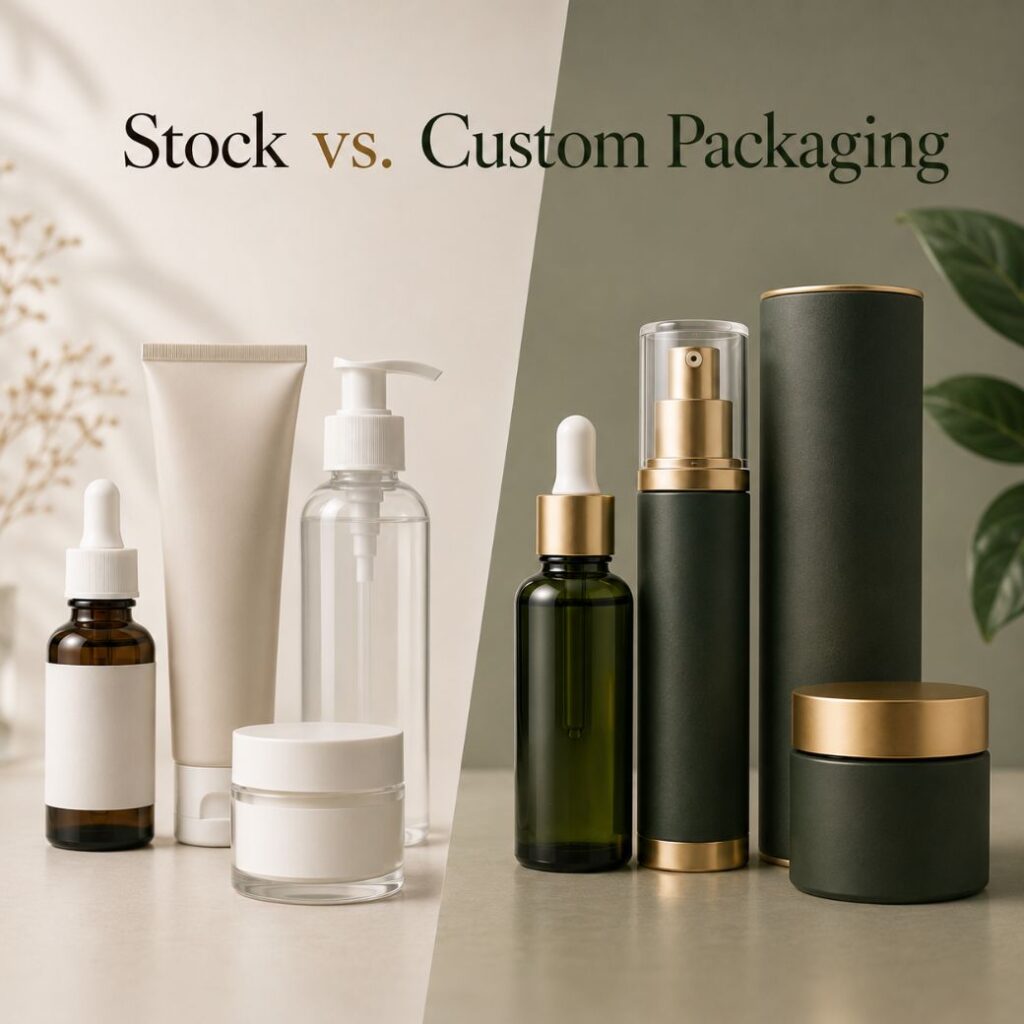
One of the first real decisions every new beauty founder faces isn’t about the formula, it’s about the bottle. The jar. The tube. And underneath that question hides a deeper one: how committed am I to this, and how fast do I need to move?
Stock and custom packaging aren’t competing philosophies, they’re two tools for two different moments in a brand’s life. Understanding the difference, and knowing when to use each, can save you months of delays, thousands of dollars in over-commitment, and a lot of sleepless nights.
Let’s break it down clearly.
What is stock packaging?
Stock packaging refers to pre-manufactured, ready-to-order containers and components that suppliers produce in bulk and hold in inventory. Think standard glass dropper bottles, generic airless pumps, classic square jars, and cylindrical tubes. These are shapes and formats that already exist, you’re selecting from a catalogue, not designing from scratch.
You can typically personalise stock packaging with your own labels, printed cartons, and colour-matched caps. But the underlying form is shared across many brands.
Advantages of stock packaging
- Low minimum order quantities often as few as 100–500 units, perfect for testing demand
- Fast turnaround orders can ship in days or weeks, not months
- Lower upfront cost no tooling fees or mould charges
- Flexibility to iterate switch or reformulate without sunk packaging costs
- Compatible with contract manufacturers who already stock matching components
What is custom packaging?
Custom packaging means designing and manufacturing packaging built specifically for your brand unique silhouettes, proprietary moulds, bespoke finishes, and materials chosen entirely by you. It’s packaging that no one else has.
This ranges from customising an existing stock shape (adding a unique closure or embossment) all the way to commissioning a completely original bottle design from concept to production.
Advantages of custom packaging
- Unmistakable brand identity your packaging cannot be confused with anyone else’s
- Retail shelf standout critical when buyers are comparing dozens of products side by side
- Long-term brand equity iconic packaging becomes part of the brand’s value
- Premium positioning bespoke design signals quality to the customer before they open the product
- Exclusivity no competitor can copy the same form
The smartest brands don’t ask “stock or custom?”. they ask “what stage am I at?” One comes before the other. Both have a place.
When does each make sense?
Choose stock when…
You’re in the early chapters of your brand story. If you haven’t yet confirmed product-market fit meaning you don’t yet know which products your customers love, at what price point, and in what quantities – stock packaging is your safest move. It keeps your capital light, your options open, and your launch timeline realistic.
Stock also makes perfect sense if you’re a direct-to-consumer brand where the unboxing experience and label design carry most of the brand story. On Instagram or TikTok, a beautifully designed label on a clean, elegant stock bottle can look absolutely premium. Consumers often can’t distinguish stock from custom when the visual identity is strong.
The DTC advantage of stock
In a world where most first impressions happen through a screen, your photography, brand identity, and label design do the heavy lifting, not the shape of the bottle. Many seven-figure DTC beauty brands built their first million in revenue entirely on stock packaging.
Choose custom when…
You’ve validated your product, you know it sells, and you’re ready to take your brand to the next level, particularly retail. Buyers at department stores and specialty beauty retailers evaluate packaging as seriously as formulation. A unique silhouette communicates that you’re a serious brand making a long-term bet.
Custom also makes sense if your brand’s point of difference is the packaging itself. Think of brands where the bottle has become iconic, the vessel is as much a part of the brand as the scent or the formula. If that’s the vision you’re building toward, custom packaging isn’t an indulgence; it’s the strategy.
A practical roadmap for new brands
Here’s how the most successful brands we work with typically approach the packaging journey:
Launch with stock , validate fastUse clean, minimal stock packaging with a strong label. Launch DTC, test pricing, gather real customer feedback. Keep your capital for product development and marketing.
Not everything needs custom packaging. Watch your sales data. One or two products will pull ahead these are your candidates for a signature custom design.
Custom takes 3–6 months. Once you know what’s working, start the design process while continuing to sell your stock version. The transition is seamless.
Roll out your custom packaging for your best-sellers. This is typically timed with a retail launch, a brand refresh, or a significant funding moment.
Even large brands use stock for new product development, limited editions, and formula testing. The two approaches coexist throughout a brand’s life.
What nobody tells you about custom packaging
Most founders underestimate how long custom packaging takes. Between initial concept, design iterations, engineering approval, sample production, and final sign-off, you’re typically looking at four to six months before a single unit is in your hands. Plan backward from your desired launch date and start earlier than feels necessary.
There’s also the question of tooling and mould investment. Depending on complexity, a custom mould can cost anywhere from a few thousand to tens of thousands of dollars. This is a one-time fee, but it’s real capital at risk, which is why validating with stock first is so valuable.
The bottom line
Neither stock nor custom packaging is objectively better. They serve different purposes at different moments. The mistake isn’t choosing one over the other, it’s choosing the wrong one for where you actually are right now.
If you’re a new brand finding your footing: start with stock, move fast, learn, and protect your runway. When the time comes to build something truly iconic, custom packaging will be waiting.
And if you’re not sure which stage you’re at? That’s what we’re here for.