Picture this: You have spent months perfecting your formula. Your packaging looks stunning. Your friends love it. Your Instagram is getting saves.
And then — silence.
Not because your product is bad. But because you launched on the wrong channel.
This is the most common — and most expensive — mistake new cosmetic founders in India make.
India’s beauty market is racing toward $30 billion by 2027. The opportunity is real. But the brands winning right now are not always the ones with the best formulations. They are the ones who understood their distribution strategy before placing their first packaging order.
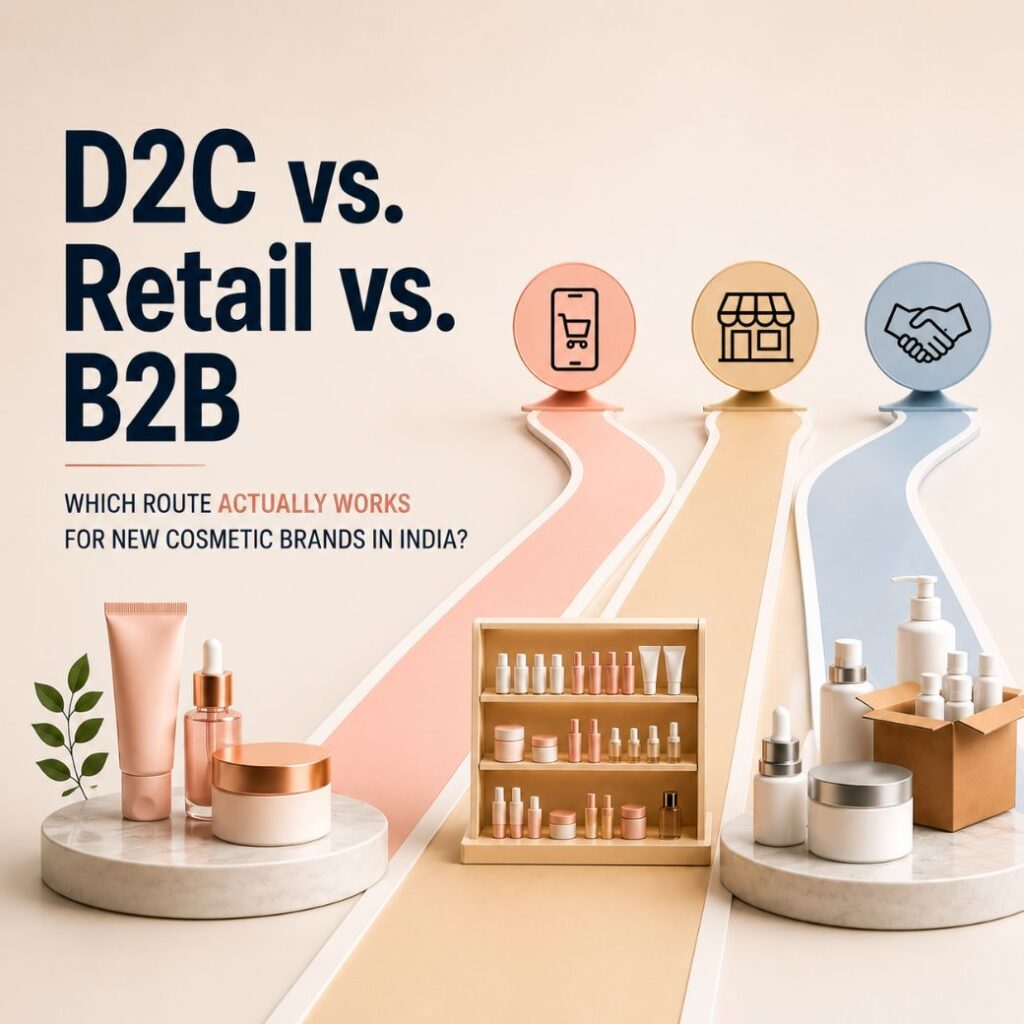
Here is an honest breakdown of the three main routes — and what each one actually demands from your packaging.
Route 1: D2C — You Own the Brand, You Own the Customer
Selling directly through your website, Instagram, or marketplaces like Nykaa and Amazon puts you in the driver’s seat. You control the story, the data, and the relationship. Brands like Minimalist, Dot & Key, and mCaffeine proved this model works spectacularly in India.
What makes it exciting
- No middlemen – higher margins, more room to invest in product and community
- Real-time customer feedback so you can improve and iterate fast
- Test a new SKU in two weeks, not two quarters
What nobody warns you about
- Digital ads are expensive, beauty brands in India often spend Rs. 400 to Rs. 800+ to acquire a single customer
- Repeat purchase rates are low without a great retention strategy
Logistics, COD returns, and packaging damage complaints will keep you up at night
What this means for your packaging
In D2C, your package is the first physical thing your customer touches. That unboxing moment? It can go viral or end up in a complaints thread.
Your packaging needs to photograph well for UGC, survive courier handling without leaking or breaking, and be light enough to keep shipping costs from eating your margin. A pump that clogs or a cap that cracks in transit does not just cost you one sale — it costs you the five-star review that would have brought ten more.
D2C packaging tip: Invest in tamper-evident, spill-proof closures early. Returns are your highest hidden cost.
Route 2: Retail — Shelf Space is Prime Real Estate
Getting onto physical shelves, modern trade (Nykaa stores, Health & Glow, Shoppers Stop), general trade (chemists, local cosmetic shops), or quick-commerce (Blinkit, Zepto) — is still how most of India actually shops for beauty.
This is the route that built Lakme, Himalaya, and VLCC. And in Tier 2 and Tier 3 cities, it remains king.
What makes it powerful
- Reach that no Instagram campaign that can replicate this
- Impulse trial — customers pick you up simply because you caught their eye
- Physical presence builds trust in ways that digital still struggles to match
What nobody warns you about
- Distributors take 15 to 25%. Retailers take another 20 to 35%. Margins get thin fast.
- Listing fees, 60 to 90 day payment cycles, and the constant threat of delisting
- You need significant inventory upfront, and cash gets locked in
What this means for your packaging
Retail packaging plays by completely different rules. Your pack has about 3 seconds and 3 feet of distance to make a shopper stop. It needs to scream its purpose clearly, survive being picked up and put down a hundred times, and meet compliance requirements for MRP, batch numbers, and ingredient lists.
The most common trap: a founder designs gorgeous D2C packaging and pushes it straight into retail. On a shelf surrounded by competitors, that minimal aesthetic becomes invisible, and the delicate closures start failing under repeated handling.
Retail packaging tip: Think billboard, not Instagram post. Bold, readable, durable in that order.
Route 3: B2B — The Quiet Engine Most Founders Overlook
Supplying to salon chains, spas, hotel amenity programmes, or white-label buyers is unglamorous. You will not see your brand name on a shelf. But a single B2B contract can generate more revenue than three months of D2C hustle, and it can fund the consumer brand you are busy building.
What makes it powerful
- Predictable, large-volume orders with far lower acquisition effort
- No listing fees, no retail margin compression, no influencer costs
- Salon distribution creates authentic word-of-mouth with real end consumers
What nobody warns you about
- Brand visibility is near zero in white-label arrangements; the client gets the credit
- Deals take 3 to 6 months to close, and price negotiation is relentless
What this means for your packaging
B2B clients care about function above everything else. Salon formats need large refillable containers, 500ml, 1L, 5L, with dispensers that work with wet hands. Hotel amenity clients want premium finishes in travel-friendly sizes. White-label buyers need packaging that can be customised with just a label swap.
And consistency is everything. One batch with a leaking closure or peeling label can end a contract that took six months to close.
B2B packaging tip: Offer flexible base packaging that clients can brand easily. It dramatically shortens your sales cycle.
So Which Route Is Right for You?
Here is what the most successful Indian cosmetic founders actually do:
Start with D2C. Your first 500 customers will tell you more than any focus group. Keep packaging nimble, do not over-invest in tooling until you know what resonates.
Add B2B in parallel. A salon deal at month 4 can fund your ad spend at month 8. These channels do not compete; they complement each other.
Enter retail with proof. Walk into a buyer meeting with D2C sales data and a waiting list. That is infinitely more powerful than a pitch deck alone.
The Real Lesson: Build Packaging for the Channel, Not the Launch
The brands that stumble are not the ones with bad products. They are the ones who designed packaging for one world and pushed it into another.
The smartest founders build a packaging architecture — a system where the same core product adapts across channels without starting from scratch every time. That means choosing a packaging partner who understands not just how things look, but how they perform on a shelf, in a courier bag, in a salon backroom, and in a five-star hotel bathroom.
Distribution is a strategy. And your packaging is the first proof of it.