Most beauty brands don’t fail at launch. They fail at growth and almost nobody talks about why.
We got a message from a founder last year that we still think about.
He had spent eighteen months perfecting his face cream. The formula was incredible, honestly, one of the best we’d seen. His first 500 units sold out in three weeks. Customers were sharing it on social media. Repurchase rates were through the roof.
He called us excited. Terrified. And completely unprepared for what came next.
“I just placed an order for 5,000 units. And I have no idea if my packaging can handle it.”
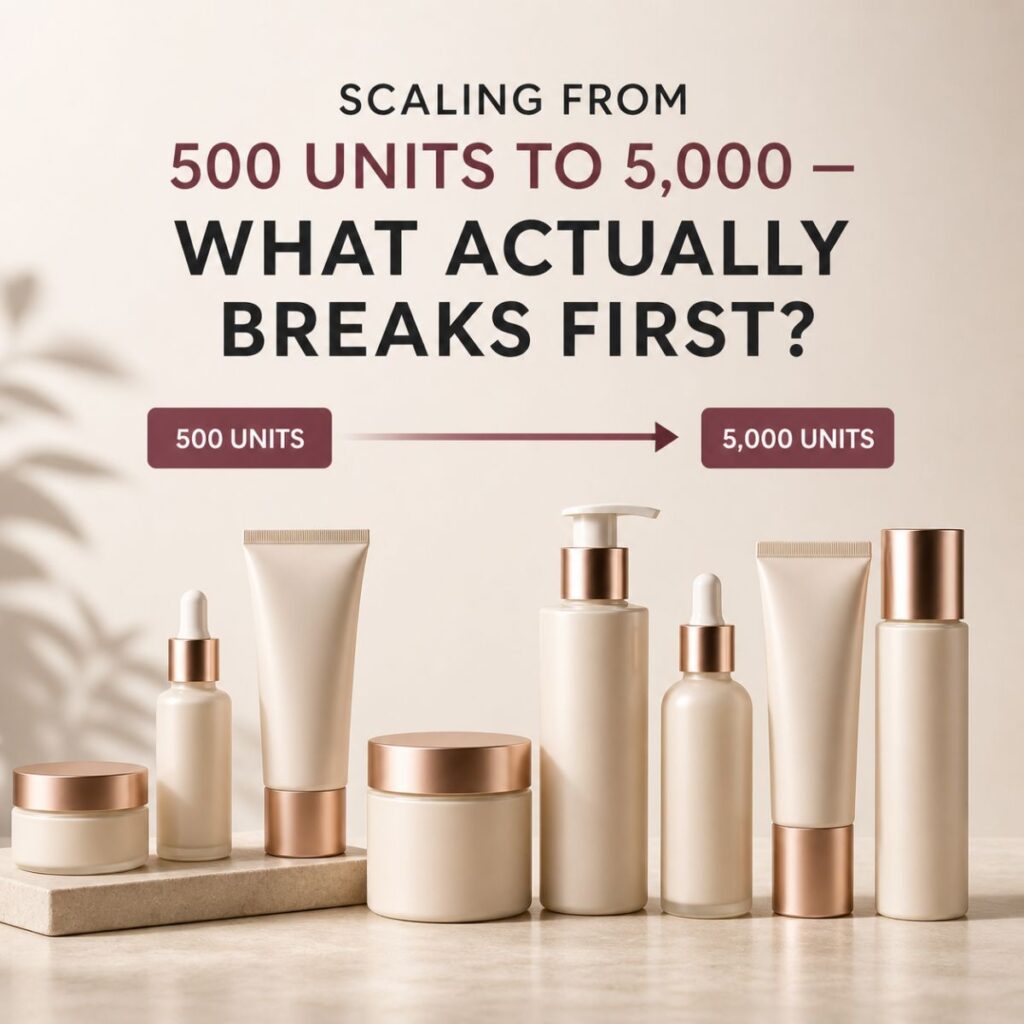
He was right to be nervous. Not because scaling is impossible, but because nobody had ever told him what actually breaks when you go from 500 to 5,000.
So we’re telling you. Right now. Before it happens to you.
First, let’s talk about why 500 units feels so good
There’s a reason the first 500 units are so magical. You’re hands-on with everything. You open the delivery boxes yourself. You spot the slightly off-colour lid before it ships. You know your supplier’s name, and they know yours.
At 500 units, you’re not running a system. You’re running on care, attention, and sheer personal investment. And it works — beautifully.
But here’s the thing nobody says out loud: 500 units isn’t a business. It’s a proof of concept.
The real test comes when the orders start multiplying and the personal touch can no longer cover for the gaps in the foundation.
So what actually breaks first?
We’ve worked with enough beauty brands to know that scaling doesn’t fail dramatically. It fails quietly. A small crack here. A delay there. A customer complaint that comes in just as you’re already stretched thin.
Your packaging supplier was never built for this volume
This one stings, because it often involves a supplier you genuinely like. At 500 units, they were responsive, reliable, and affordable. But at 5,000? Your order is suddenly five times bigger, and they’re juggling ten other clients who grew too.
Two-week turnarounds become six. You send a message. You get a reply three days later. Stock “should be arriving soon.” Meanwhile, your launch window is closing.
The honest truth: Most small packaging suppliers are optimised for small orders. Before you scale, ask directly: “Can you handle 5,000 units, reliably, every month?” Their hesitation will tell you everything.
The lid that was perfect at batch one starts leaking at batch seven
Quality control at 500 units is personal. You touch the product. You feel the cap. You notice when something’s off. At 5,000 units, it becomes statistical, and statistics have variance.
Customers who loved your product start posting photos side-by-side. “Did they change the packaging?” They didn’t. But consistency slipped, and in luxury beauty, consistency IS the product.
What actually helps: Don’t just approve a sample. Require your packaging partner to document finish specifications — gloss levels, colour codes, torque standards — and hold every batch to the same benchmark.
A six-week delay at 5,000 units is a crisis. At 500, it was an inconvenience.
Beauty moves fast. Seasons change. TikTok trends peak and fade in three weeks. When your packaging arrives late, you don’t just miss a deadline. You miss revenue, momentum, and sometimes the entire window during which a trend was open.
We’ve watched brands lose retailer listings because their packaging didn’t arrive in time for a confirmed shelf slot. That’s not a packaging problem. That’s an existential brand problem.
The fix is unglamorous: Buffer time. Written lead time commitments. A packaging partner who shows up when they say they will — not just when it’s convenient.
Your brand starts looking like two different brands
Here’s something that rarely gets talked about: finish drift. The sleek, uniform black-capped jar that defined your brand gradually starts to look different batch by batch. The cap is a slightly warmer black. The surface texture is a touch more glossy.
Individually, none of these things are disastrous. Together, they quietly erode the premium feel your brand was built on. Brand equity is patient work. Finish inconsistency undoes it fast.
What we do differently: Every production run is checked against documented standards — not memory, not “it looks about right.” Colour references. Surface specifications. Torque requirements.
Suddenly, you’re paying for inventory before you’ve sold the last batch
Nobody warns you about this one clearly enough. At 5,000 units, you’re placing an order that costs five times more — before you’ve finished selling your previous stock, before the revenue has landed in your account.
The brands that don’t make it through scaling often aren’t failing because of bad products or poor marketing. They’re failing because the cash flow math caught up before the revenue did.
Ask the questions early: Can your packaging partner offer phased delivery? Flexible MOQs? A good packaging partner should want to help you scale sustainably — not just take a large order.
The system that lives in your head can’t scale with you
At 500 units, you remembered everything — which cap, which batch, which courier. It lived in your head, maybe with a backup in a Notes app. At 5,000, that system breaks the moment you’re tired or trying to do two things at once.
Wrong caps get ordered. Specs get confused between old and new versions. Small errors at scale become expensive problems.
What the brands that make it do: They document everything before they need to. Packaging specs. QC checklists. Reorder timelines. They treat operations like a machine — one that doesn’t rely on any single person’s memory.
Here’s the part we really want you to hear
The brands that grow from 500 to 5,000 — and then to 50,000 — aren’t luckier than the ones that stall. They’re just more intentional about building the foundation before the pressure arrives.
Your formula can be extraordinary. Your marketing can be brilliant. But if your packaging fails at scale, the customer never gets to experience any of it.
A note from us at CMKart Global Private Limited
We built our business for exactly this moment — the moment when a founder looks at a 5,000-unit order and feels the weight of everything that could go wrong.
Every jar. Every lid. Every cap — built to the same standard at 5,000 as it was at 500.
If you’re approaching that scaling moment, we’d love to talk before the cracks appear.
Let’s build your packaging foundation the right way.