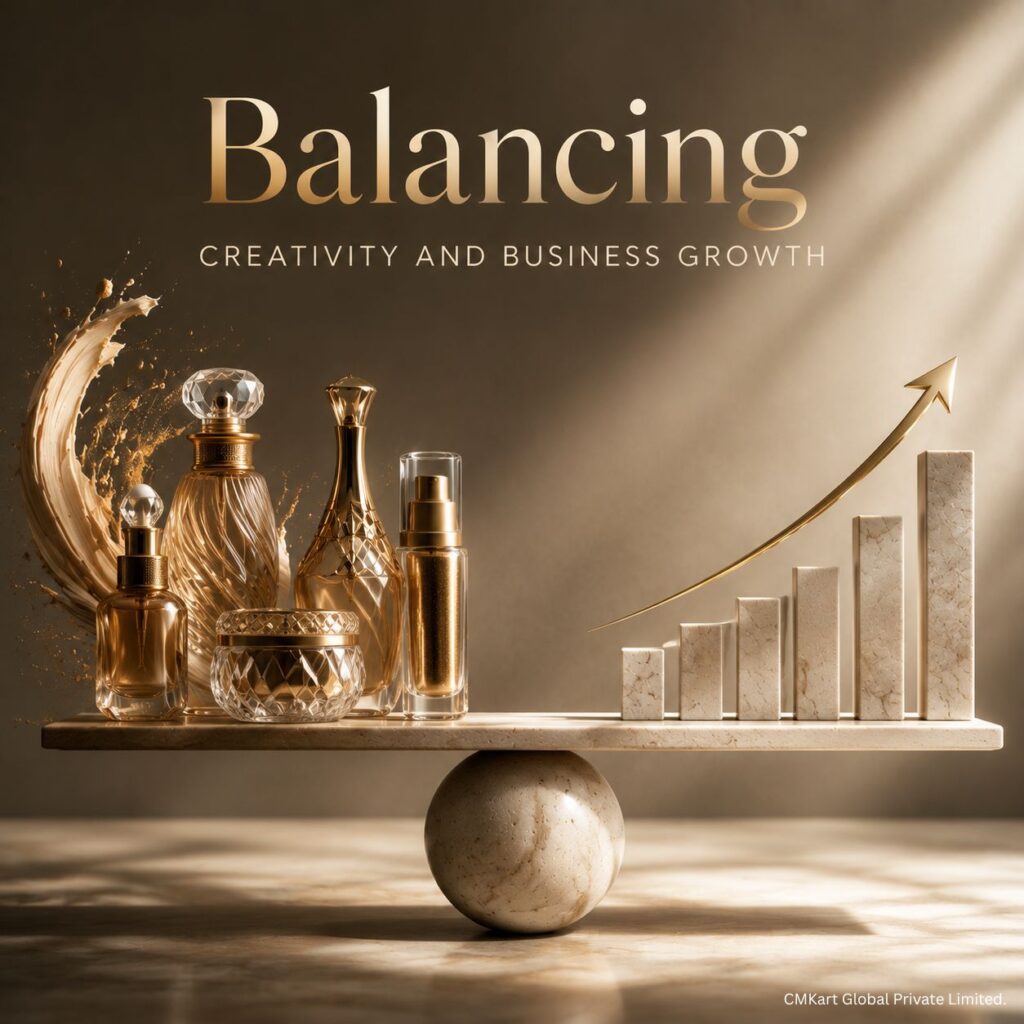
Every founder starts with a creative vision. A product idea that felt different. A brand aesthetic that felt personal. A point of view that felt worth building something around.
Then growth happens. And with it comes pressure to standardise, to streamline, to make decisions based on data rather than instinct. Slowly, almost without noticing, the creative energy that started everything begins to feel like a luxury rather than a necessity.
The beauty and cosmetic industry feels this tension more sharply than most. It is an industry built on creativity, on colour, on texture, on identity, and on desire. But it is also one of the most competitive commercial landscapes in the world, where margins are tight, trends move fast, and the gap between a brand that scales and one that stalls often comes down to how well creative vision and business discipline are held together.
New brands enter this space every week. Most have a strong creative start. Fewer make it past the first few years with that creative identity still intact because somewhere along the way, growth pressured them into choices that made business sense but slowly hollowed out the brand. Understanding why that happens, and how to avoid it, is what separates the brands that last from the ones that fade.
This blog is about why that trade-off is a false choice, what actually happens when brands get the balance wrong, and how to build a brand where creativity and growth don’t compete; they compound.
The False Choice Between Creativity and Growth
The idea that creativity and business growth are in tension is one of the most persistent myths in brand building. It gets reinforced every time a fast-scaling brand loses its personality in pursuit of efficiency. Every time a founder is told to “think more commercially”. Every time a bold creative decision gets overruled by a committee optimising for the average.
But look closely at the brands with the most durable growth, the ones that have scaled significantly without becoming generic and you’ll find something consistent. They never treated creativity as a phase they’d eventually grow out of. They treated it as a competitive advantage they couldn’t afford to dilute.
Creativity is not the opposite of business discipline. It is the reason the business had something worth disciplining in the first place.
The product, the identity, the voice, the aesthetic – all of it started as a creative decision. Growth doesn’t make those decisions less important. It makes them more important, because the stakes of getting them wrong are higher.
What Happens When Creativity Takes a Back Seat
The consequences of letting growth override creativity rarely arrive dramatically. They arrive gradually, in ways that are easy to dismiss until they become impossible to ignore.
The brand voice starts sounding like everyone else in the category. The product line expands but loses its point of view. The visual identity becomes inconsistent as more people make decisions about it with less context. The customers who were drawn to the original vision start drifting toward newer, more distinctive brands that remind them of what yours used to feel like.
And the hardest part is that none of these are obvious in the moment. Each individual decision to standardise a label, to simplify a design, or to tone down a campaign seems reasonable in isolation. It’s only in aggregate that the creative erosion becomes visible. By then, rebuilding what was lost costs far more than protecting it would have.
Growth built on a diluted identity is growth with an expiry date.
What Happens When Creativity Ignores Business Reality
The reverse is equally true and equally damaging. A brand that prioritises creative vision at the expense of operational and commercial reality doesn’t scale; it stalls.
Beautiful products that aren’t priced correctly. Distinctive packaging that isn’t manufacturable at volume. A brand identity so niche that it can’t expand into adjacent categories without feeling incoherent. Creative decisions made in isolation from the market realities that determine whether a business survives.
Creativity without business grounding produces brands that are admired but not sustained. The goal isn’t to choose creativity over strategy or strategy over creativity. The goal is to build a brand where the two are genuinely inseparable.
The Brands That Get It Right
The brands that manage to scale without losing themselves share one important characteristic: they treat creative decisions with the same rigour they apply to business decisions. Not the same process, but the same seriousness.
Creative direction is not left to whoever has time for it. It is owned, protected, and revisited with intention as the brand grows. The visual identity evolves deliberately rather than drifting accidentally. The brand voice is documented and maintained, not assumed to be understood by everyone who joins the team. The product experience, every touchpoint a customer has with the brand, is considered holistically rather than optimised in isolated pieces.
These brands also understand something that takes most founders a while to learn. Scale doesn’t dilute creativity. Lack of creative discipline does. A brand can grow to ten times its original size and still feel entirely like itself if the people building it never stop caring about the details that made it distinctive in the first place.
How to Protect Creativity as Your Brand Grows
The practical answer to this challenge isn’t a single strategy. It’s a set of habits that keep creative vision present in business decisions at every stage of growth.
Start with a clear creative point of view, not a mood board, but an articulated perspective on what your brand believes, how it communicates, and what it will never compromise on regardless of commercial pressure. This becomes the filter through which growth decisions are made.
Make creative integrity part of every business review. When a new product is being developed, when packaging is being updated, when a campaign is being planned, the question shouldn’t only be “Will this sell?” It should also be “Does this still feel like us?”
Protect the details. The details are where brand identity lives, and they’re the first things to go under growth pressure. The font choice, the finish on a package, the tone of a customer email, the way a product is presented on the website. Each one is a small creative decision. Together they are the brand.
Hire people who understand both sides. The tension between creativity and growth isn’t resolved by separating them into different teams. It’s resolved by building a team where both considerations are present in the same conversations and respected equally.
The Bottom Line
Creativity and business growth are not enemies. They are, at their best, the same thing: a distinctive, well-executed idea that the market wants and the business can sustain.
The brands that figure this out don’t just grow. They grow in a direction that still makes sense. They build customer loyalty that compounds over time. They create something that has a reason to exist beyond the next sales target, and that reason is what makes them worth coming back to.
Protect the creative vision. Let the strategy serve it. Build a brand that is as distinctive at scale as it was at the start.
That’s the version of growth worth building toward.